
Your cart is currently empty!
Category: Lifting Journey to Rim-Hanging Glory
-
Week 7: Sleepy Strides
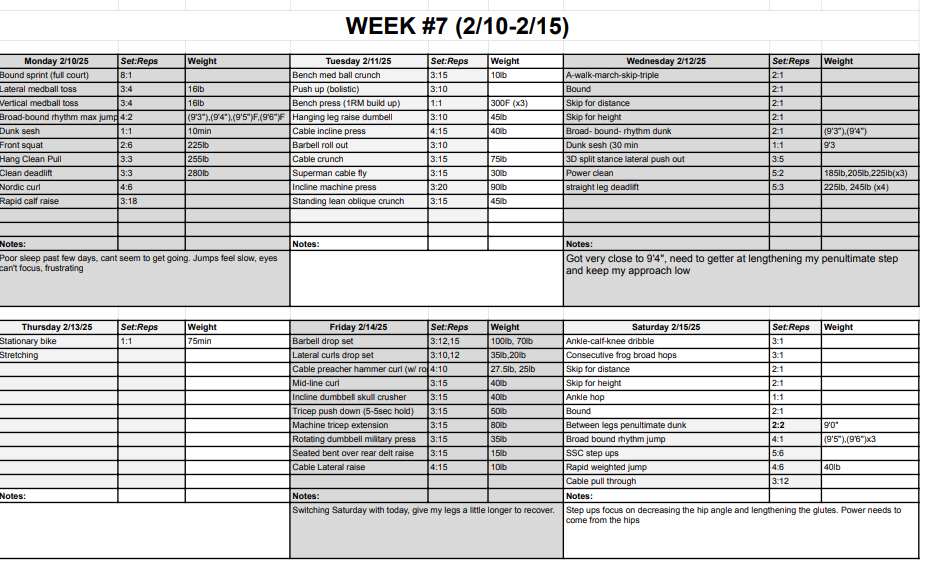
Ah, Week 7—a time when even my pre-workout needed a pre-workout. Despite my best efforts, including a full scoop of my trusty go-go juice, I found myself yawning through warm-ups and contemplating a nap between sets. Spoiler: gym floors aren’t as comfy as they look.
The Great Broad Jump Bust
In my quest for personal bests, I tackled the Broad to Bound Rhythm Jump with all the enthusiasm of a caffeinated kangaroo. However, after multiple failed attempts at a personal best and accepting the fact that today just wasn’t gonna be the day. I also realized that my whole plyo sesh might be shot. I made a few attempts in a small dunk session that was to embarrassingly pathetic to even go into detail.
Friday Night Lights (Out)
Thinking I was clever, I shifted my plyometric day from Friday to Saturday, banking on extra rest to channel my inner superhero. But after a late-night movie, I showed up on Saturday moving like a sloth in molasses. Note to self: “women weaken legs” Mic (Rocky)
Glute Activation: The Real MVP
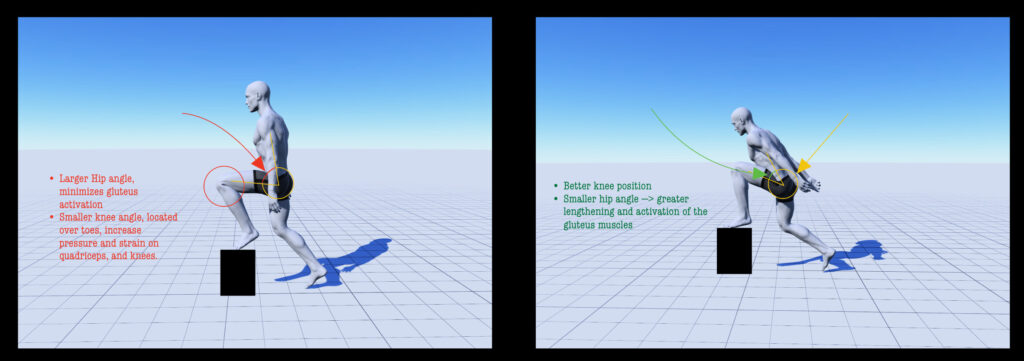
Despite my sleepy saga, I’ve tried to focus on glute activation. Turns out, waking up those posterior powerhouses is crucial. Research backs this up, showing that exercises like step-ups, hip thrusts, and lunges are top-tier for firing up the gluteus maximus.
The Penultimate Perplexity
I’ve noticed a pesky habit: shortening my penultimate step before jumps. This misstep (pun intended) messes with my momentum and increases ground contact time. Experts agree that a properly executed penultimate step is key for optimal jump performance.
Strength Training: When in Doubt, Lift
On days when my nervous system feels like it’s running on dial-up, I’ve turned to strength exercises targeting the glutes. Movements like hip thrusts and split squats not only keep me active but also help in building that posterior chain. Plus, there’s something satisfying about lifting heavy things, even when you’re half-asleep.
Takeaway
This week was a reminder that rest is as vital as reps. Prioritizing sleep, maintaining proper form, and listening to my body’s cues are essential. And maybe, just maybe, I’ll set a bedtime alarm to avoid future Friday night follies.
-

Week #6: “Jumping through hoops”
So, here we are—week 6 of my vertical jump and dunking journey. Things have been moving, but let’s be real, I’m tired. Not the “oh, I did a couple of extra sets and feel tired” kind of tired, but the “I’m running on fumes and trying to convince my body to do plyos at 5 AM” kind of tired. But hey, the grind doesn’t stop, right?
Plyometric Days: The Usual Jumping Around, But With a Twist
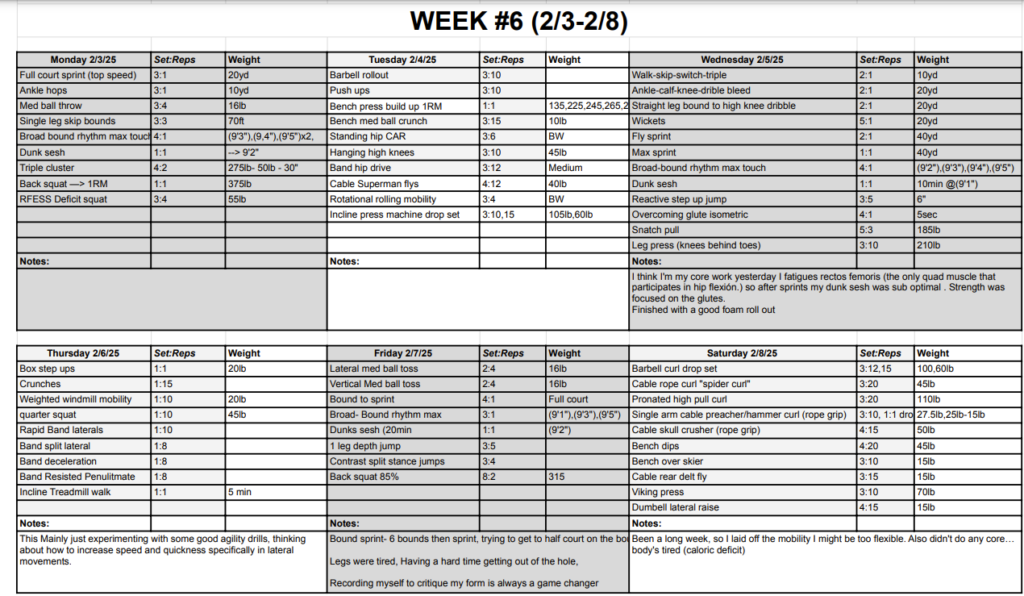
Monday, Wednesday, and Friday were my plyometric days. These sessions are always intense, but I’ve got a little trick up my sleeve now: med ball throws. I’ve been incorporating them at the start of my plyo workouts to set up my body for the explosive moves to come. This little addition is based on a principle known as Post Activation Potentiation (PAP), which basically means I’m trying to fire up my nervous system by doing some heavy-resisted, explosive lifts before jumping into the lighter, higher-intensity plyos.
In short: lift heavy, then jump high. And it works.
PAP has been backed by research, with one study from Journal of Strength and Conditioning Research (2016) suggesting that “pre-loading” your muscles with a heavier resistance right before doing explosive activities can lead to greater force production and enhanced performance in jumps and sprints. So, that’s what I’m banking on. Med ball throws to warm up, then bam—into the plyos, trying to go higher with every rep. Honestly, though, this kind of explosive training really only works if you’re giving 100%. Which brings me to my next point…
Fatigue: A Constant Companion
This week, though, that 100% was harder to give than usual. Between late nights finishing assignments for school and those oh-so-early 4:30 AM wake-ups to get my workouts in, my energy levels have been scraping the bottom of the barrel. The workout intensity has been there, but my body’s not really following orders. I push through the best I can, but you can only be so explosive when your body feels like it’s running on empty. And let’s be honest, the mental fight is just as draining as the physical one.
But hey, that’s what this journey is all about, right? Pushing through when things get tough.
Arm Workout: Some Wins, Some… Not So Much
Saturday rolled around, and it was time for my arm workout. I made a few adjustments, which is always a gamble. Some things went great, and others… not so much.
I kept the cable preacher curls because those things just hit my biceps like a freight train. If you’ve never tried them, trust me, you’re missing out. The activation is on point. But the shoulder work, oh boy. Shoulders are tough to train. They’re like that one person in the group project who can’t ever seem to pull their weight, no matter how hard you try.
Here’s the thing: when you try to overload the shoulders too much, you end up recruiting the trapezius, levator scapulae, and a bunch of other muscle groups that aren’t supposed to be involved in your shoulder work. It’s like trying to do a plank, but instead of engaging your core, you start shaking your arms like a spaghetti noodle. So, to properly train the shoulders, the key is finding that sweet spot where the weight is heavy enough to challenge the muscle without getting all these rogue muscles involved. But finding that sweet spot is tricky—too light, and it doesn’t work; too heavy, and you’re doing more harm than good. It’s a delicate balance.
I’ve been reading some expert opinions on this, and as National Academy of Sports Medicine expert Dr. Mike Reiman says, “To effectively target the deltoids, you need to ensure you’re using appropriate resistance—one that activates the shoulder without overloading accessory muscles like the traps or upper back.” So, yeah, I’ll be adjusting my weights next time, but it’s a process.
The Struggle of Training When You’re Exhausted
Let’s face it, training when you’re exhausted is one of the hardest things to do, especially with plyometrics. You need that max effort to see progress, but your body’s like, “Yeah, no thanks, I’ll sit this one out.” It’s a tough spot to be in because you want to give it everything, but the body’s like, “Hey, remember that assignment you stayed up until 2 AM finishing? Yeah, I’m still tired from that.” I can’t skip the work, but I also can’t ignore the fatigue. It’s all about pushing through and finding ways to optimize what I can while I’m running on fumes.
But that’s the thing about a journey like this—it’s not just about the physical training. It’s about learning how to balance all the other demands in life, keeping your mind focused, and giving your best even when you’re exhausted. So, while my vertical jump might not have increased by a foot this week (I can dream, right?), I’m still learning, still growing, and still making progress.
In Conclusion
Week 6 is in the books. I’ve learned that post-activation potentiation works wonders for my jumps, but fatigue makes it harder to push myself to the max. My arm workout was a mix of success and struggle, but that’s the nature of this process. You can’t expect every workout to be perfect, but the key is to keep adjusting and improving. If I can push through these fatigued workouts and still make progress, then I know I’m on the right track.
And with that, I’ll finish up my late-night assignment, get ready to hit another 4:30 AM wake-up, and keep going. The journey continues.
-
Week #5 “Jumping Higher & Fighting Evolution”
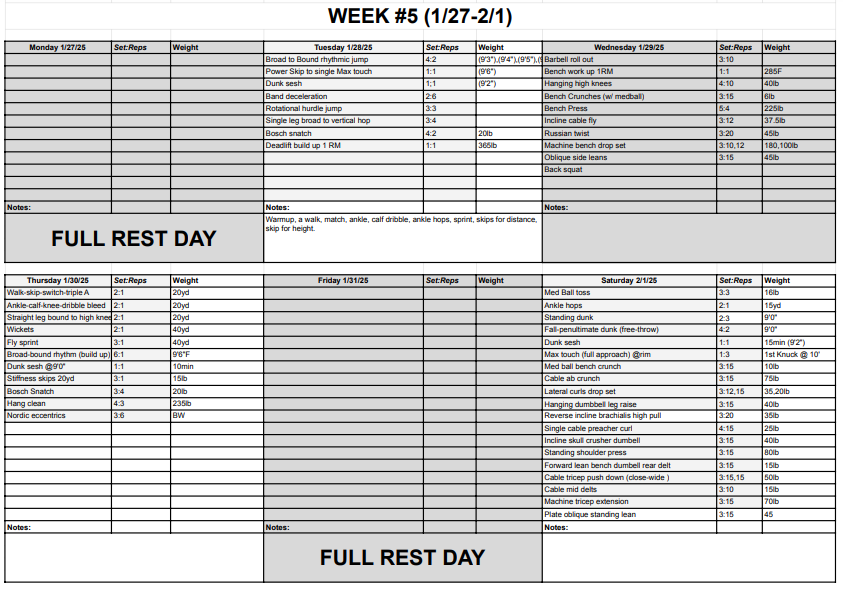
Tuesday, Thursday, and Saturday were my designated plyo days this week, and let me tell you—by Saturday, my legs were questioning all my life choices. Monday and Friday were full rest days, or at least that’s what “life” says. I honestly have no idea what I did last Friday. Could’ve been productive, could’ve been asleep on the couch with a snack in hand. Either way, if you’re up late, don’t force yourself through a workout the next morning. Your nervous system will be too fried to fire properly, and you’ll just end up reinforcing bad movement patterns or tweaking something. Not worth it.
Saturday’s Long Haul
By the time Saturday rolled around, I managed to complete my third plyo session of the week, along with my usual upper-body work. And because I love questionable decisions, I had thrown in a one-rep max deadlift—which, unsurprisingly, left my back sore for days. No matter how much I focus on technique, deadlifts always wreck my back in a way no other lift does.
Maybe it’s because, when I was in high school, I found out my back was actually broken. Yeah, fun discovery. Leading up to that, I had multiple workouts where I was in serious pain, but I chalked it up to just “lifting hard.” Turns out, nope—just structural damage! Even now, after over a decade of training, my lower back still feels weak compared to the rest of my body. So deadlifts and I have this love-hate relationship: I love doing them, and they hate me right back.
Fixing the Right Hip Pop (No, Not a Dance Move)
For years, anytime I did mobility work—especially bench sit-ups—I’d feel my right hip subtly pop. Never painful, just annoying, like my body was reminding me it had a sense of humor. This week, I tried something different: holding a medicine ball between my knees while doing crunches. Game-changer. Not only did it add resistance to the movement, but it also engaged my hips in a way that stopped the popping. Sometimes, a small tweak is all it takes to fix a lingering issue.
The Fun (and Humbling) Plyo Drills
I also added a handful of more advanced plyo drills this week, like rotational hurdle jumps and single-leg broad-to-vertical hops. These kinds of movements are great because they push your limits and test your coordination. Also, they’re the drills most likely to remind me that gravity is undefeated.
Which brings me to a realization: Humans weren’t built for speed and power. We evolved to be endurance monsters, not explosive jumpers. The ability to chase something down over miles? Yeah, that’s in our DNA. The ability to dunk a basketball? Not so much. So every time I do these drills, I can feel millions of years of evolution working against me, and honestly, that underdog feeling is pretty motivating. Who doesn’t love proving nature wrong?
-

Week #4 “From Squats to Sky: Building My Dunk with Back Squats”
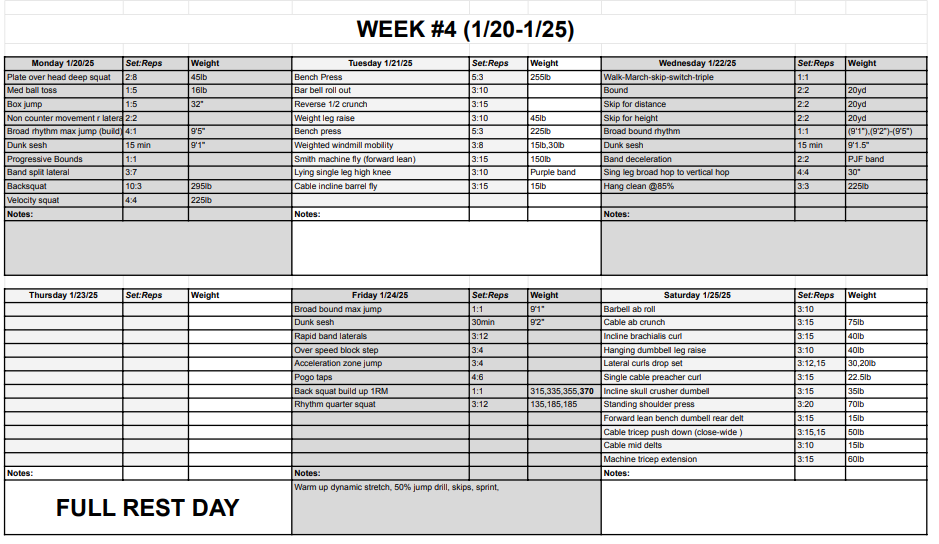
I’m deep into my dunk journey, and this week was a rollercoaster. Plyo days were solid—I hit my Monday, Wednesday, and Friday sessions like clockwork. But Thursday? Thursday, I was cooked. My plan was to go in for some rehab, core, mobility, and stability work, but my body had other ideas. Instead of forcing it, I just rested, and honestly, sometimes that’s the best move you can make.
The Dangers of Overtraining: More Isn’t Always Better
It’s easy to think that more work equals more gains, but there’s a point where you’re just digging yourself into a hole. Overtraining is real, and if you don’t respect your body’s need for recovery, you’ll end up stalling—or worse, regressing. Research published in the Journal of Strength and Conditioning Research found that excessive fatigue impairs motor unit recruitment, meaning your muscles literally stop working as efficiently. Another study in Sports Medicine highlighted how overtraining leads to prolonged recovery times, decreased power output, and even hormonal imbalances.
Long story short: if you feel like a zombie, don’t try to train like an Olympian. Sometimes, the best thing you can do for your gains is to take a nap.
Squatting for Vertical Gains: The Angle-Specific Approach
This week, I also hit back squat multiple times and even attempted a one-rep max. Not a true powerlifting squat, though—I’m training for jumping, not a powerlifting meet. And that means focusing on angle-specific strength.
Research in the Journal of Applied Biomechanics shows that training at joint angles specific to your sport leads to better force production at those angles. Translation: if you want to jump higher, train your squat at your jump-specific knee angle. Going “ass to grass” is cool for general strength, but it doesn’t translate directly to jumping, where your knee angle is much shallower. Plus, taking forever to get out of the hole wastes time, and the key to jumping high is spending as little time on the ground as possible.
Strength vs. Speed: Why You Need Both
Plyos are crucial—probably the most important part of the equation—but there’s a ceiling. At some point, you have to ask yourself, do I even have enough horsepower to get off the ground any higher? That’s where strength training comes in.
A study in The Journal of Sports Sciences found a strong correlation between maximal squat strength and vertical jump performance. Basically, the stronger your legs, the more force you can put into the ground, and the higher you go. But it’s not just about raw strength—there’s a balance. Research from The National Strength and Conditioning Association (NSCA) suggests that once you can squat 2 to 2.5 times your body weight, additional strength gains don’t provide as much of a return for your vertical jump. So, if you’re squatting barely over bodyweight, you have a ton of room to grow. If you’re already squatting double your body weight, it’s time to focus on speed-strength and plyos.
The Takeaway: Train Smart, Not Just Hard
You can get your little chicken legs firing as fast as possible, but at some point, you’ll need to upgrade to a stronger set of legs. My plan? Keep balancing plyos with strength work, train my squat at the angles that matter, and listen to my body when it needs rest. Dunking isn’t just about jumping—it’s about training the right way, recovering well, and stacking small wins over time.
-

Week #3 “Dunk Training: Sprinting, Sleep Deprivation, and My Useless Dump Truck”
I’m three weeks into my quest to finally throw down a dunk, and things are getting interesting. This week was a mix of breakthroughs, setbacks, and a harsh realization that my glutes might just be for show. Let’s break it all down.
Plyo Days & Sprinting for Gains
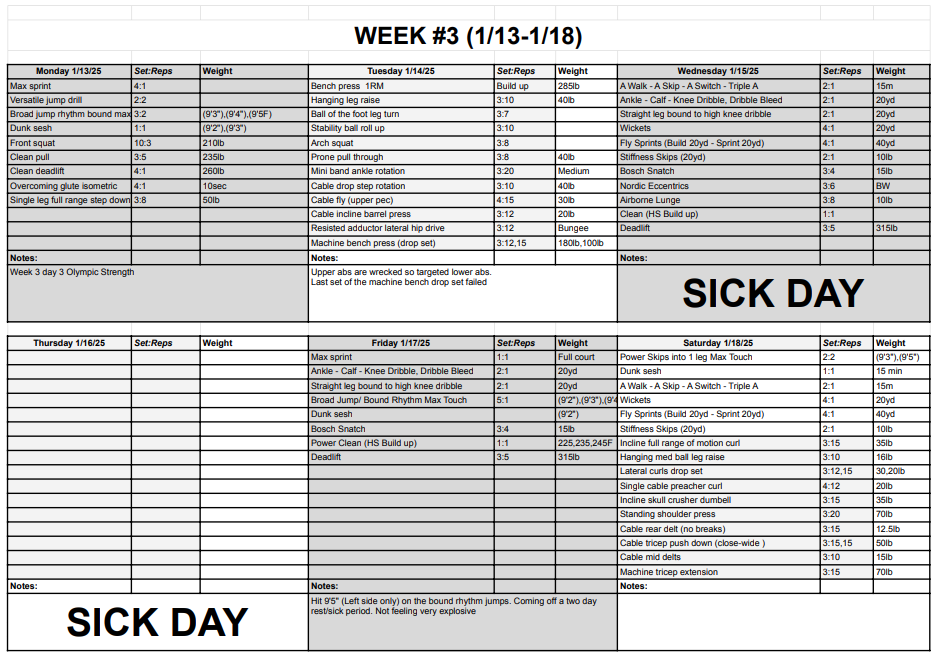
Monday, Wednesday, and Friday were my dedicated plyo days, but I’ve started incorporating more sprinting into the mix. Sprinting isn’t just about running fast—it’s a powerhouse for developing explosive power, tendon stiffness, and coordination. Paul Fabritz’s “Speed Code” program has been a huge influence, and I’ve been hammering sprint mechanics and max effort runs to help build that freaky vertical.
There’s actual science backing this up, too. Studies show that sprinting increases tendon stiffness, which is crucial for producing force quickly—aka, jumping higher. A study published in the Journal of Applied Physiology found that athletes with stiffer Achilles tendons had better sprinting and jumping performance. Makes sense—if your tendons are more elastic and can store energy efficiently, you’re basically turning your legs into high-powered springs.
I also mixed in some max-effort cycling, but not in the “spin class with Karen” kind of way. I mean cycling through the phases of a sprint while focusing on force production, knee drive, and foot contact. I want my body to get better at producing force fast, and sprinting is one of the best ways to do that.
Sleep Deprivation & Gym Discipline
This week, my wife was really sick which meant I was up late a couple of nights. Naturally, that turned into a few “sick days” for me, which in reality just meant unexpected recovery days. The important thing is that I still made it to the gym and got my workouts in. My wife and I say this all the time: Anyone can go to the gym when they feel good and have time. What separates people is showing up when you don’t want to, when you’re exhausted, when motivation is at rock bottom. Those are the days where, even if you’re not setting PRs, you’re actually building something more valuable—consistency.
James Clear, the Atomic Habits guy, summed it up perfectly: “You do not rise to the level of your goals. You fall to the level of your systems.” The system is showing up, no matter what. So yeah, maybe I didn’t get my best lifts in this week, but I showed up, and that’s what counts.
The Bosch Snatch & My Glute Awakening
This week, I discovered an exercise that might just change everything for me—the Bosch Snatch. I picked this up from the Vert Code, and it’s quickly becoming a favorite because it actually helps me feel my glutes working. Anyone who’s done serious weight training knows how important the mind-muscle connection is, and studies back this up. Research in The European Journal of Applied Physiology found that individuals who could create a stronger neural connection with their muscles saw better muscle activation and growth.
This is huge for me because I’ve always struggled to feel my glutes engage when I run, jump, or squat. And that’s a problem because the glutes are the powerhouse for jumping. They’re the biggest muscle in your body, and if they’re just chilling while you attempt to take off, you’re leaving a ton of potential vertical inches on the table.
My Completely Unscientific Theory on Jumping Genetics
A lot of people think jumping is all genetics, and to some extent, that’s true. But I think the genetic component isn’t about how high you can jump outright—it’s about how efficiently your body contracts and produces force. Some people can naturally engage their muscles better than others. For example, I have a friend who can engage his glutes effortlessly when sprinting, while I struggle to activate mine. Despite being blessed (or cursed?) with what he refers to as a “dump truck of an ass,” my glutes aren’t doing much for my vertical. Apparently, they’re just there for aesthetics.
So, my goal now is to improve my neuromuscular connection and get my glutes firing properly when I jump. That means more exercises like the Bosch Snatch, single-leg movements, and drills that emphasize hip extension. If I can turn my glutes from decorative cushions into actual power generators, I think I’ll see some real improvements in my jump.
Moving Forward
Next week, I’m dialing in even more on sprint mechanics and muscle activation. I also need to make sure I’m actually recovering properly—sleep is just as important as training, and I’ve been running on fumes. But if there’s one thing I’ve learned, it’s that showing up and putting in the work, even when conditions aren’t perfect, is what makes the difference in the long run.
Now, if you’ll excuse me, I have some glutes to wake up.
-

Week #2 Toddler-Induced Bicep Cramps
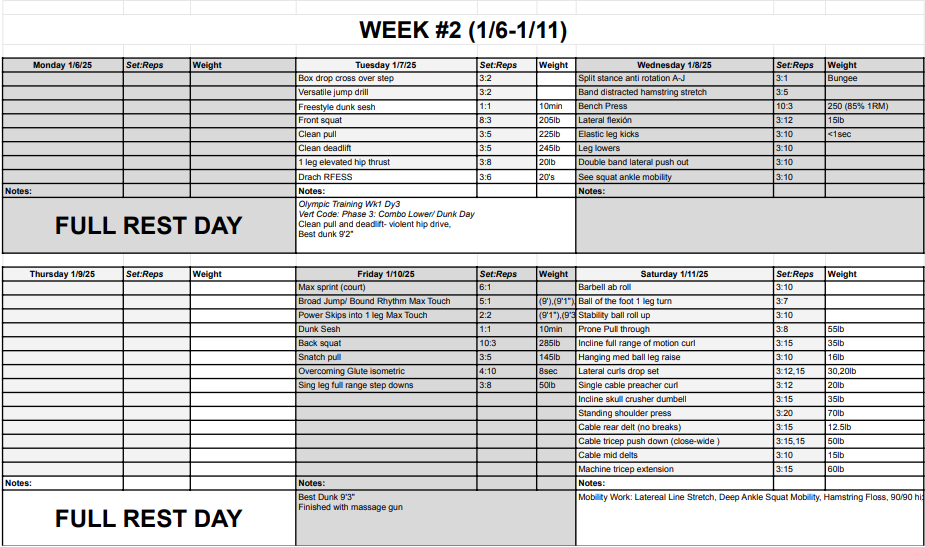
Week two of my training journey has come and gone, leaving me with a mix of triumphs and sore muscles. After indulging in a two-day recovery period on Sunday and Monday, I felt rejuvenated and ready to tackle the challenges ahead.
Tuesday: Embracing Plyometrics and Olympic Lifts
The day began with my usual warm-up routine: a session with the massage gun to ease muscle tension, followed by static stretching to improve flexibility. Incorporating light plyometric movements like skipping and sprinting not only prepared my body for the workout but also contributes to enhancing my vertical jump performance.
I included isometric holds such as wall sits and glute bridges to activate key muscle groups. The main workout consisted of a series of bodyweight plyometric exercises. By allowing full recovery between sets and maintaining low repetition ranges, I targeted type II fast-twitch muscle fibers, essential for explosive power.
Transitioning to Olympic lifts, I focused on single lifts near my one-rep max for multiple sets, followed by lighter, higher-rep exercises to complement the main lift. This approach aimed to enhance neuromuscular recruitment, allowing for strength gains without significant muscle hypertrophy.
Wednesday: Prioritizing Rest and Recovery
Recognizing the importance of rest, I dedicated Wednesday to recovery and mobility work. Incorporating anterior core exercises strengthened my abdominals, and a heavy bench press session targeted high weight for low reps across multiple sets. This method effectively developed neuromuscular recruitment, enabling strength improvements without substantial increases in muscle size.
Friday: Revisiting Plyometrics and Olympic Lifts
Friday’s routine mirrored Tuesday’s, with a focus on plyometric exercises and Olympic lifts. Emphasizing explosive movements and strength development, I ensured adequate rest between sets to maintain performance quality.
Saturday: Upper Body Maintenance
After a week centered on lower body training, I dedicated Saturday to upper body maintenance, focusing on biceps, triceps, and shoulders. The goal was purely aesthetic—to maintain muscle mass and ensure a balanced physique. While upper body strength doesn’t directly contribute to vertical jump performance, maintaining muscle mass is important for overall balance and appearance.
This session was intense enough that later, when I tried to pick up my two-year-old daughter, my fatigued biceps protested, reminding me of the workout’s intensity. They cramped on me so tight I had to set her down. Who would have thought training you arms would make it so you couldn’t pick up your kids?
Conclusion
Week two presented its challenges, but each session brought me closer to my goals. Balancing intensity with adequate recovery remains crucial. Listening to my body and adjusting the training load as needed will help prevent overtraining and promote continuous improvement
-

Week #1 “From Snatch to Dunk: My Olympic Lifting Journey to Rim-Hanging Glory”
Hey fitness enthusiasts! Buckle up as I take you through my latest training regimen—a rollercoaster of Olympic lifts, plyometrics, and the ever-crucial recovery sessions. Let’s dive into the nitty-gritty, sprinkled with some science.
Neuromuscular Recruitment: The Olympic Odyssey
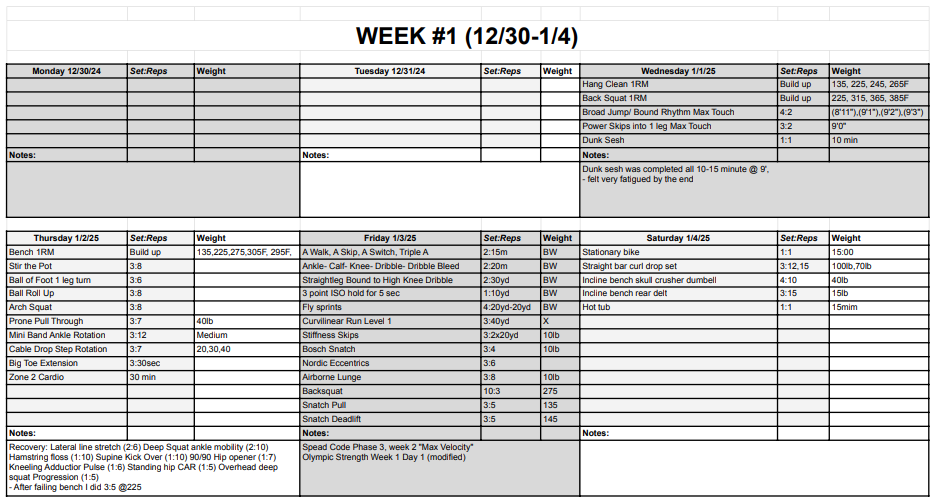
I kicked off my routine focusing on neuromuscular recruitment through heavy Olympic lifts. For those scratching their heads, neuromuscular recruitment is essentially getting as many muscle fibers as possible to join the party during a lift. Studies have shown that Olympic weightlifting exercises and their derivatives have relatively high motor recruitment, with more complex exercises requiring more units.
Remember, it’s not about the weight but the form and control. If you’re lifting more than me, hats off! Just ensure you’re moving safely and activating the right muscle groups.
Chest Day Extravaganza
Mid-routine, I shifted gears to prevent my chest muscles from feeling neglected. Enter: high-volume chest day. The goal? Provide enough stimulus to require recovery and sustain the chest muscle without much stimulus throughout the week.
This approach aligns with the SAID principle—Specific Adaptation to Imposed Demand—which means our bodies adapt specifically to the demands we place on them.
So, by bombarding the chest with volume once a week, I ensure it stays robust without overtraining.
Lower Body Powerhouse
Back to the grind with a focus on lower body strength and explosiveness. These exercises not only build strength but also enhance power output, crucial for athletic performance.
Upper Body Light Day
I also incorporate a lighter day, targeting upper body muscle groups to maintain balance. The idea here is to apply the SAID principle without confusing the body with equally strong stimuli for the upper and lower body. Prioritizing recovery and rest is paramount.
Rest and Reflect
A day dedicated to recovery, foam rolling, and contemplating why I subject myself to this routine. But hey, no pain, no gain, right?
Final Thoughts
This regimen was about testing the waters of my joint health and stability before diving into a more demanding phase. If you’re following along, adjust the weights to your personal level. The key is controlled movements, safety, and proper muscle activation.
As a benchmark, I’m starting with the ability to dunk a basketball comfortably with two hands on a 9-foot rim. The goal is a clean two-handed dunk on a standard 10-foot rim, with the ability to hang from it—because style points matter.
Remember, specifics on exercise form can be found on YouTube or Google. And always listen to your body; it’s the only one you’ve got.
Stay strong, stay safe, and keep lifting!
-

Every Journey begins with a single…jump!
After years of jumping attempts that barely cleared a phone book, I’ve decided it’s time to take my vertical leap from “meh” to “magnificent.” Drawing inspiration from experts like Paul Fabritz and Andy Galpin, along with my own trial-and-error escapades, I’m crafting a program aimed at transforming average athletes into elite jumpers.
- Strength Training: Building a solid foundation with exercises like squats and deadlifts to power up those leg muscles.
- Plyometrics: Incorporating explosive movements such as box jumps and depth jumps to boost fast-twitch muscle fibers.
- Flexibility and Mobility: Ensuring joints and muscles are limber through dynamic stretching and mobility drills.
- Nutrition: Fueling the body with a balanced diet rich in protein, complex carbs, and healthy fats to support training and recovery.
- Rest and Recovery: Prioritizing sleep and rest days to allow muscles to repair and grow stronger.
The Game Plan:
By blending these elements, I’m on a mission to defy gravity and achieve a vertical leap that would make even the most seasoned athletes nod in approval. Stay tuned as I document this journey, sharing the highs, the lows, and the occasional faceplants along the way.
For those looking to embark on a similar quest, remember: it’s not about where you start, but the dedication and effort you put into the journey. Let’s leap into greatness together!