Your cart is currently empty!
Author: Nelson Brown
-
Week #17 “From C-Section to Sit Ups”
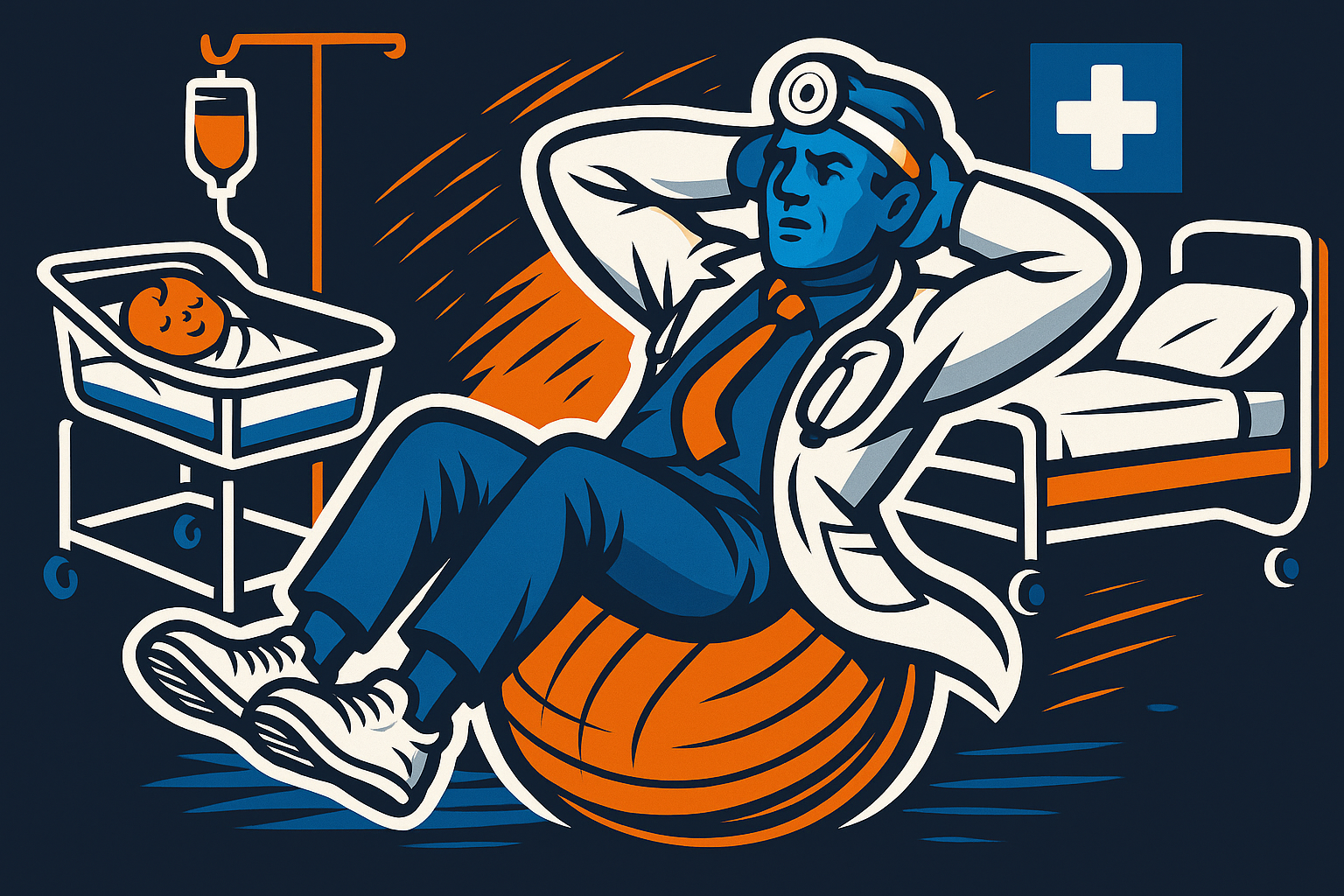
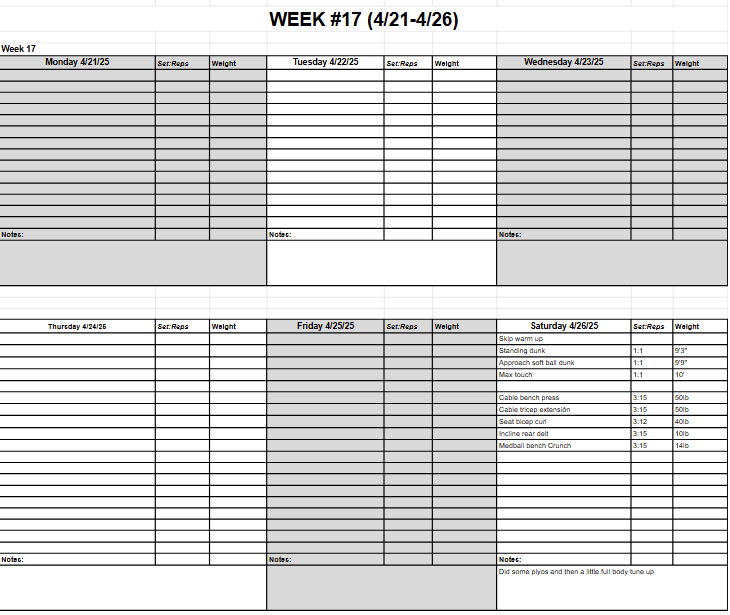
My workout journal from that week might as well have evaporated into the ether. Before you crack it open and start judging my lack of detailed notes, pump your brakes. Last Friday night, instead of tracking sets and reps, my wife and I rolled into the hospital for a scheduled induction to welcome our second child—a little baby boy who decided to announce himself in C-section style.
My wife—five-foot-one, one-hundred pounds of pure “Yes-I-can” (as her dad endearingly calls her; and accurately so)—was determined to prove our first-child doctor’s anatomical theory wrong. After our daughter arrived via c-section, we were told it had nothing to do with her effort, but rather that her birth canal “might just be too small.” So with renewed fire—and under the counsel of a new physician who said she could give vaginal delivery a shot even though our little guy was measuring big—she went into labor at 39 weeks.
Twenty four hours of contractions later—and four straight hours of pushing—the attending physician gently informed us that the baby still wouldn’t clear the pubic bone. Heartbroken but immensely proud of her superhuman effort, we made our way back into the OR. Thirty minutes later, baby boy #2 arrived via the same incision as his sister.
Twenty-four hours into her post-op recovery—just as we thought we were out of the woods—my wife began writhing in flank pain so excruciating it might as well have come from a passing kidney stone. They whisked her back into the OR and removed what turned out to be a fragment of her kidney lodged in her ureter—an ultra-rare complication that nobody ever warns you about. It seems that her Herculean labor effort strained her body so intensely that a piece of her own kidney literally broke off.
While my wife—former track athlete, rugby player, and certified badass—recovered from that second procedure, I traded gym time for hospital hallways. Sure, I managed the occasional burst of push-ups by her bedside, a few sit-ups on her birthing ball, and some mobility stretches to keep me from feeling like a soggy noodle. But truly, my training log lay dormant for six straight days as I focused on caring for my family.
When Science Meets Reality: Postpartum Recovery Isn’t One-Size-Fits-All
The sports-science world loves to study young male athletes, but postpartum rehab? That field feels like the Wild West. Women are routinely told not to lift more than ten pounds for weeks—an amusing suggestion if your newborn weighs eleven, which happened to my mother. And while you’re warned about diastasis recti and loose skin, solid, practical guidance on rebuilding strength and tissue mobility is scarce.
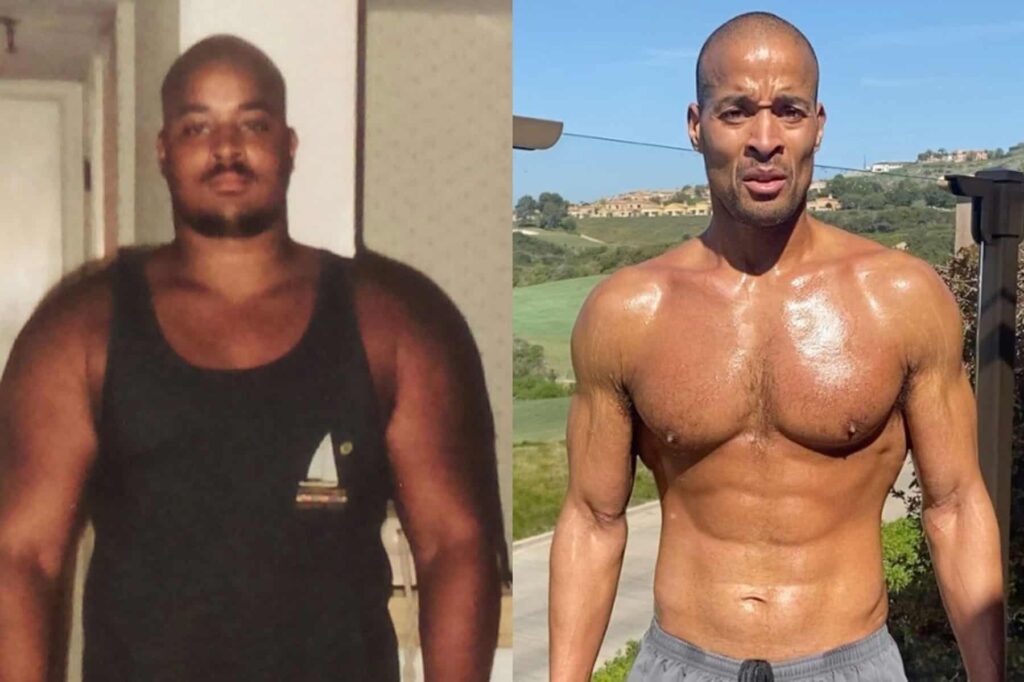
Enter David Goggins’ “500 Rule.” You might know Goggins for dropping over a hundred pounds in three months, yet emerging with hardly a stretch mark in sight. His secret? Towering rep counts with progressively lighter loads—forcing constant muscle pumps that drive oxygen-starved muscle fibers to call for new capillaries and blood vessels. This angiogenesis doesn’t just bulk up muscle; it benefits the overlying skin and fascia, improving nutrient delivery and waste removal—key for skin elasticity and scar remodeling .
For postpartum women, that translates to a golden window. Relaxin—the hormone that softens pelvic ligaments and abdominal tissues for birth—lingers for months, keeping tissues malleable. Scar tissue, however, begins solidifying within weeks. So the goal becomes clear: gently load the area early to guide healing, then progressively challenge it before the body “locks in” its post-birth architecture.
A Blueprint for Rebuild: My Wife’s Roadmap
Weeks 0–2 (Healing Phase):
- Pain-guided movement: Gentle diaphragmatic breathing and pelvic tilts to encourage blood flow without overstressing incisions.
- E-Stim Activation: Fifteen-minute sessions over the rectus abdominus to recruit muscle fibers and boost local circulation.
Weeks 3–6 (Reactivation Phase):
- High-rep, low-load work: Bodyweight air squats, banded deadlifts, and cable crunches—keeping the pump alive while respecting ligament laxity.
- Scar mobilization: Light massage and myofascial release techniques to prevent adhesions and promote tissue glide.
Weeks 7+ (Hypertrophy & Strength Phase):
- Progressive resistance: Gradually increasing load on core exercises, maintaining rep ranges of 20–30 to sustain capillary stimulus.
- Functional integration: Farmer carries, loaded carries, and compound lifts to restore full-body coordination.
Throughout, she’s monitored her pain on a scale of 0–10, allowing up to a 4/10 discomfort that doesn’t intensify during or after exercise. If the pain creeps higher, we dial back.
Lessons Learned Beyond the Lab
Watching my wife bulldoze through two surgeries and then methodically rebuild her strength reminded me that the parameters we study in journals—hormone levels, capillary growth, fascial remodeling—only tell half the story. The other half is grit, patience, and flexibility when the manual offers blank pages.
For any partner or parent in the trenches: prioritize empathy over programming. Swapping your personal bests for supportive squats and midnight feed “sets” doesn’t diminish your credibility—it expands your capacity as an athlete, teammate, and human being.
And when you’re finally ready to lace up your own shoes again, remember this: recovery is its own event. Respect its phases, lean into the low-load hypertrophy that nurtures both muscle and skin, and cherish every incremental gain—because the strongest athletes aren’t defined by bar speed alone, but by their ability to rally back from the toughest of rounds.
-
Week #16 “Snooze you lose: Turned Plyos into Plodios”
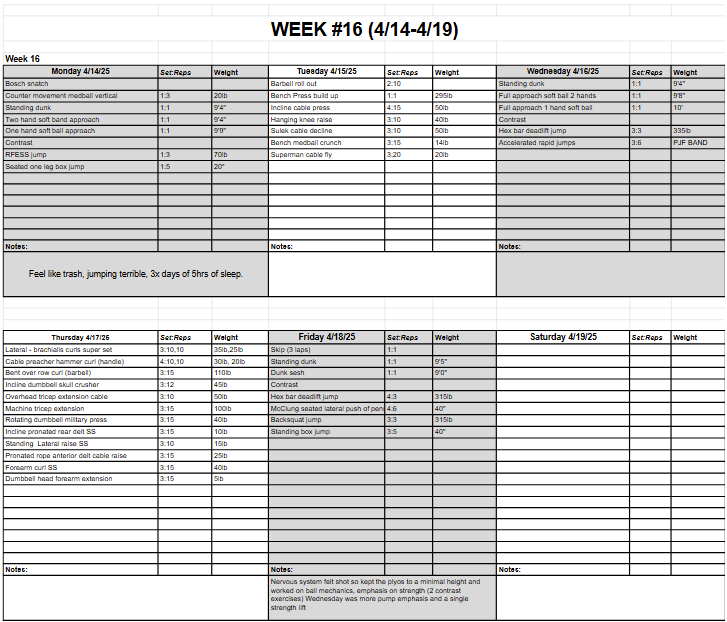
I can’t believe I’m writing this a month later—my notebook from that week might as well be a black hole. What I remember most vividly is how I was dragging myself through three plyometric sessions on barely five hours of sleep per night. That little detail felt insignificant at first—“I’ll power through,” I told myself. But the truth is, running your body on five hours when you know you need seven to eight is like trying to torch through canyon walls with a soggy blowtorch. You might get sparks, but you’ll never breach the barrier.
When I finally paused to reflect, the science slapped me in the face. A recent meta-analysis found that acute sleep deprivation reduces explosive power by nearly 40 percent and slows high-intensity speed by over 60 percent—exactly how my legs felt when I limped into the gym for my third session of the week PMC. Every jump felt muted, every sprint sluggish. It wasn’t just subjective fatigue; measurable drops in performance were happening. Imagine trying to fire Roman candles with wet matches—you get a flicker, then nothing.
Beyond slowed performance, the research highlights a cascade of biochemical consequences. Partial sleep deprivation spikes inflammatory markers—IL-6 and C-reactive protein climb, signaling your body to batten down the hatches instead of building new muscle tissue PMC. In my case, that meant joint stiffness lingered longer, and muscle soreness crashed in waves rather than tapering off. It’s like your body sets up roadblocks on every recovery avenue, leaving you gridlocked between workouts.
Hormones don’t escape unscathed either. I remember checking my mood mid-block and feeling more wired than usual—only to realize my cortisol was likely through the roof, while growth hormone pulses that rebuild muscle fibers were MIA. A controlled trial on resistance-trained athletes showed that total sleep loss elevated cortisol/testosterone ratios and blunted IGF-1 levels, even though strength recovery wasn’t statistically delayed PubMed. In plain English: my body was in a catabolic state, tearing down more than it could build up.
That felt like driving a sports car with the parking brake on. Every heavy lift or depth jump carried an extra layer of friction, and the mental edge I associate with plyometrics—explosive intent, razor-focus—had all but vanished. The workout that usually has me buzzing like I downed three espressos was reduced to a checkbox chore.
One thing I leaned on is the simplicity of box jumps. There’s no overthinking: you load the stretch-shortening cycle, you explode, you land. But even box jumps betrayed me that week. A systematic review underscores their value for honing landing mechanics and stretch-shortening efficiency—critical for both performance and injury prevention ScienceDirect—yet without adequate sleep, my landing felt sloppy. I’d hit the top of the box but wobble on landing, like a tightrope walker who skipped leg day.
I can still see myself, mid-flight, thinking, “C’mon, you’ve done this a thousand times.” But the body had its own agenda, and science confirms that neural drive to muscles is compromised under sleep debt. Fast-twitch fibers misfire, coordination falters, and what should feel instinctual becomes awkward. It was a humbling reminder that no matter how seasoned you are, you can’t out-smart physiology.
Wrestling with that week’s failures forced a reckoning: if I respect my own advice about loading and potentiation, I have to extend the same respect to recovery. Sleep isn’t a passive state where gains happen by accident; it’s the prime time when your body reads its blueprint, patches microtears, and refuels neurotransmitter pathways. Skimp on sleep, and you’re essentially building a house on shaky ground.
Now, I’m treating sleep like a training partner. I’ve instituted a strict “lights out” policy at a consistent hour, avoiding screens and ambient noise beforehand. I’m logging those precious five to six extra hours I’d once shrugged off. It feels almost indulgent—like hitting the spa instead of the squat rack—but research shows that sleep extension alone can improve athletic performance, mood, and metabolic health—even if it doesn’t replace every aspect of training Nature.
Reflecting back, I see that week as a valuable lesson wrapped in discomfort. I’ll never forget the sensation of my body begging for mercy, of neural pathways dragging like wet rope. But by embracing sleep as a core component of my program—right alongside squats, sprints, and box jumps—I’m setting the stage for gains that don’t fizzle out by Wednesday.
So tonight, I’m tucking in early, knowing that each hour of shut-eye is an investment in my next jump, my next sprint, and my next victory over gravity itself. Because in the end, you can’t cheat sleep any more than you can cheat physics—and that’s a truth worth writing home about.
-

Week #15 “Fuel the Bounce”
After diving into months of calorie tracking like it was my side hustle, I had a revelation: I was chronically underfeeding myself carbs. Shocking, I know. Here I was thinking I was on top of my diet game, but in reality, I was cruising through workouts on half a tank of gas and wondering why my engine kept sputtering.
I’m 200 lbs, I train hard for 2 hours a day, and I’m generally more active than a caffeinated toddler. I should be eating around 400g of carbs a day to support all of that. Wanna guess how much I was averaging? Around 200g. That’s not “no bueno,” that’s carb neglect.
The Protein Bias
I’ve always been focused on protein, and rightfully so—it’s the golden child of macros. Every fitness influencer, bodybuilder, and probably your mom’s chiropractor tells you to “hit your protein.” So, I did. Religiously. Unfortunately, that always came at the expense of carbs.
Carbs are tricky. Everyone agrees they’re important for training, recovery, and performance—even in fat loss. But tracking them sucks. Why? Because carbs are delicious and unforgiving in small doses.
“They bake fresh chocolate chip cookies, let you take one bite, and then rip the plate away.”
That’s what it feels like trying to stick to moderate carbs. It’s not even hard to track—it’s just emotionally devastating. But this week, I made the commitment to fix that.
Fueling Performance: Carbs Matter
Carbohydrates are the primary fuel for high-intensity training. A review in the Journal of Sports Sciences (Jeukendrup, 2011) emphasized that adequate carbohydrate availability is essential for maintaining training intensity, delaying fatigue, and promoting glycogen resynthesis.
Research shows that during resistance training and explosive movements, muscle glycogen is the dominant fuel source. Depleted glycogen levels impair performance and recovery (Kerksick et al., 2018).
Even among bodybuilders, carb manipulation plays a big role. Carb cycling—alternating high and low carb days—is a common strategy used to support training on high-volume days and manage fat loss on off days. Studies suggest that while carb cycling doesn’t magically boost fat loss, it helps maintain training intensity and muscle glycogen on key days (Campbell et al., 2020).
In short: carbs aren’t just good for energy. They are vital for performance, especially when you’re pushing yourself in the gym or on the court.
Clean, Boring, Beautiful Fuel
So how do you get 400g of carbs while keeping everything else in check? With the cleanest, most disciplined diet ever. I’m talking pressure-cooked chicken, rice, broccoli, fruit. That’s right, I’ve essentially become a walking meme—the chicken and broccoli guy.
I mapped out a perfect day, meal prepped the entire week, and ate the same meals daily. Exciting? No. Effective? You bet.
The Outcome? PR City
- Day 1: Nothing major
- Day 2: Meh
- Day 3: BOOM. PR Dunked @—10’ with a dodgeball. That’s a 30” vertical for those keeping score.
“Talk about getting a little taste!”
And I’ve gotta say, I felt more energized in the gym, more focused, and my training intensity went up. Even post-workout, my legs felt fatigued—which is good. Before, I felt more systemic fatigue, like I’d just tried to outrun a bear while hungover.
Training Adjustments: Some Good, Some Not
Contrast training continues to be my bread and butter. I pair heavy lifts with explosive plyos, keeping it tight and effective. Still doing:
- Isometrics at jump angles
- Core work
- Hip mobility on recovery days
But I made one change that didn’t quite hit the mark: I tried doing my heavy contrast training BEFORE my plyos, then wrapping up the session with more lifting. The idea was to prime the muscles for better explosive output.
Did it work? Kinda. But I also gassed out quicker. I got fewer quality jumps and needed more recovery. So, back to the drawing board.
The Warm-Up Wake-Up Call
Now let’s talk about mornings.
My alarm goes off at 4:30AM, and I’m on the court jumping by 5:00AM. That’s not normal. That’s what you do when you have a family, a job, and a dream of dunking on your brother by the end of the year. “Merry Christmas Mother F#$&*@!”
But your body? It doesn’t care about your dreams. It cares about circadian rhythms. There’s research suggesting that performance varies based on time of day due to chronotype differences—aka early birds vs. night owls.
“It is somewhat genetic. Everyone has different tolerances and preferences toward their periods of activity.”
Anthropologists have even theorized that humans evolved with diverse wake/sleep schedules to maintain 24-hour vigilance in tribal groups. So, when I’m crawling out of bed to hit the gym, it’s not just hard—it’s literally fighting evolution.
Waking the Beast
To get moving, I use a tried-and-true cocktail of:
- Pre-workout (duh)
- Fast carbs (banana or rice cake)
- Dynamic warm-ups: jump rope, bounds, hops
- Music that convinces me I’m in an action movie
But moving forward, I’m shifting my warm-up to be lower intensity, higher volume—just doing more of what I’ll be doing (but chill). Less pre-fatigue, more nervous system prep.
Final Thoughts: Fuel the Machine
This week confirmed a few things:
- Carbs are not evil, they’re just needy.
- Prepping your food = prepping your success.
- You can’t out-jump poor fueling.
- And PRs feel way better than being slightly leaner.
So I’m staying the course, riding the carb wave, and looking forward to more vertical gains.
More to come. For now, I’m off to eat more rice.
References:
- Jeukendrup, A. E. (2011). Nutrition for endurance sports: Marathon, triathlon, and road cycling. Journal of Sports Sciences, 29(Suppl 1), S91–S99.
- Kerksick, C. M., et al. (2018). International Society of Sports Nutrition position stand: Nutrient timing. Journal of the International Society of Sports Nutrition, 14, 33.
- Campbell, B. I., et al. (2020). Intermittent dieting: theoretical considerations for the athlete. Strength & Conditioning Journal, 42(6), 25–32.

-
Week #14 “Lessons in Hunger and Hops”
New month, new week, and I was reinvigorated with optimism and delusion. Instead of living in a constant state of caloric deprivation, I thought: why not go hard for one week—super low calorie—and then return to maintenance the next? You know, get the fat loss out of the way fast so I can get back to gains and gym glory.
Let me save you the suspense: it didn’t work. I tried to starve the beast…. It ate me instead.
You can’t cage the beast (referring to your appetite) and then expect it to sit quietly in the corner when you finally let it out. I went 5 days strong eating only 1500 calories per day, which for a grown man who trains almost daily, is basically a hunger strike.
And then… the beast got out. For 3 days, despite my best intentions, I ate over double that amount each day. Because as I’ve said before: “The bill comes due… always.”
Contrast Training Continues
On the performance side of things, I’ve continued using contrast training during my plyo court sessions. I’ll finish every plyometric session with two heavy-and-explosive circuits:
- Heavy compound movement (like squats or hex bar pulls)
- Followed by unloaded plyometric movement (like broad jumps or pogo hops)
The key? Keep it intentional. Not just moving weight, but moving weight with intensity, and executing the plyos with max intent.
Active Recovery and Isometric Work
On my active recovery days, I’ve shifted focus toward:
- Hip mobility drills
- Light cardio (just enough to break a sweat)
- Isometric holds for tendons and joint health
These are slight resistance, maximal contraction holds—usually held for 10–20+ seconds. Research has shown that isometrics can improve tendon stiffness and reduce pain, especially in chronic conditions like tendinopathy (Rio et al., 2015).
I don’t push too hard—after all, it’s a recovery day—but I treat these holds as neuromuscular tune-ups.
Enter: Eccentric Deceleration Training
Inspired by that legendary podcast with Stuart McMillan, I finally dove into eccentric strength training. If you recall from my earlier posts, McMillan dropped this bombshell: eccentric strength is what separates average athletes from elite athletes.
So here’s what I’ve been doing:
- Load a hex bar with 65–75% of bodyweight
- Stand on stacked bumper plates (about 6” height)
- Step off into a depth drop while holding the weight
- Relax the posterior chain into normal jump mechanics
- Decelerate as fast as possible to stop the weight before it hits the ground
These drills train the body to absorb force quickly and efficiently. During sprinting and jumping, your joints can experience forces 4x your bodyweight. If you’re not trained to handle that, your body engages the Golgi tendon organ, a neat little feature that shuts off muscle activity to prevent injury (aka the “collapse like a noodle” response).
Progressive eccentric training like this can help desensitize that GTO response, improving your ability to accept force, and eventually produce more of it.
Behold: A PR Standing Vertical
Despite a pretty exhausting week of chronic under-eating followed by gluttonous rebound eating, I finished strong.
This week I hit one of my highest standing vertical jumps ever: 10’1″ touch with a standing reach of 7’8″—that’s a 29” standing vert.
Let me just remind you:
- Average vertical jump for males? 16–20”
- NBA average? Around 28”
So despite what TikTok or YouTube might tell you, I’m not average. And yet… still not dunking.
Why?
Well, as I graciously admitted: “My standing vert is just a few inches short of Shaquille O’Neal’s… and he can dunk, and I can’t.”
But that’s because he’s 7’1” and his standing reach is somewhere near 9’5”. So yeah, there’s a little problem,
“You can’t coach height.”
Wrap-Up: Feed the Beast… Strategically
This week was a lesson in biological rebellion. You can try to cheat your metabolism, but your body has been around longer than your willpower.
I’m sticking with my contrast and eccentric training, will start a new nutrition protocol next week so stay tuned.
One more inch at a time on that vertical.
“Rome wasn’t build in a day”References:
- Tillin, N. A., & Bishop, D. (2009). Factors influencing post-activation potentiation in humans and the effects on performance. Sports Medicine, 39(2), 147-166.
- Rio, E., Kidgell, D., Purdam, C., Gaida, J., Cook, J., & Pearce, A. J. (2015). Isometric exercise induces analgesia and reduces inhibition in patellar tendinopathy. British Journal of Sports Medicine, 49(19), 1277–1283.

-
Week #13 “When You Body Hits the Eject Button on Gains”
Well, as expected, I was royally wrecked this week. Apparently, five hours of intense plyometrics for a guy pushing 30 comes with a receipt—and this week, the piper came to collect. I tried to play it cool, pretending nothing had changed, but my body quickly hit me with the equivalent of a “sit down and shut up.”
The Deload Heard Around My Hamstrings
After a couple of embarrassingly weak sessions—where I felt like my legs were filled with mashed potatoes and shame—I realized it was time to shut her down. Some people call this a deload. I call it a necessary ego-check.
Deloading isn’t just about being lazy (although let’s be honest, it’s a little nice). It’s actually backed by science. According to a review published in the Journal of Strength and Conditioning Research, short-term rest or reduced training volume can help mitigate accumulated fatigue, improve recovery, and maintain performance during long-term training plans (Pritchard et al., 2015). Basically, your body builds up stress, fatigue, and micro-damage—and every so often, you need to reset, like when you have computer problems and after cursing in your mind for half a day you break down and call someone who tells you to “turn it off, then back on again”.
So midway through the week, I hit the brakes, took a couple of days off, and focused on not becoming a human puddle.
My Shoulder: Also Not Having a Good Time
Oh, and remember that slightly tweaked shoulder from volleyball last week? Yeah, that didn’t exactly help things. I figured I could keep playing through it—as one does when they’re stubborn and in denial—while alternating between massaging, applying pressure, and pretending it wasn’t happening.
Spoiler: it was definitely happening.
Chest Day: The One Shining Moment
With the legs out of commission, I shifted focus to my midweek chest workout, which doubles as active recovery after my first plyo day. Oddly enough, I’ve been seeing solid gains in my flat bench 1-rep max, probably because I’m new enough to the movement that even doing it wrong leads to progress.
Truthfully, I don’t love flat bench. I don’t get a great mind-muscle connection, and it almost always leaves my shoulders grumbling.
After that, I move into cable work—a series of flys, presses, and pumps so intense, you start to worry if your milk is coming in.
Slippery Slope of Recovery Guilt
Now, I’d like to tell you it was a productive, thoughtful week of listening to my body and prioritizing recovery—but let’s be real. I was kicking myself for having to rest. Valuable training days, gone. My workouts slipped, my diet followed, and I found myself eating a bit more, putting on some extra fluff, and generally getting undisciplined in multiple areas of life.
Sometimes you just push yourself too hard, and by the time you realize it, you’ve already dug yourself into a hole. It would be lovely if we could push our bodies relentlessly without retaliation, but your body has a way of getting even.
Final Thoughts: Don’t Poke the Bear (a.k.a. Your Nervous System)
If I’ve learned anything this week, it’s that your body will tell you when it’s had enough—and if you ignore it, it’ll shout.
Moral of the story: take care of your body, and it will take care of you.
Lesson learned.
References:
- Pritchard, H. J., Keogh, J. W., Barnes, M. J., & McGuigan, M. R. (2015). Effects and mechanisms of tapering in maximizing muscular strength. Journal of Strength and Conditioning Research, 29(5), 1285–1294.

-

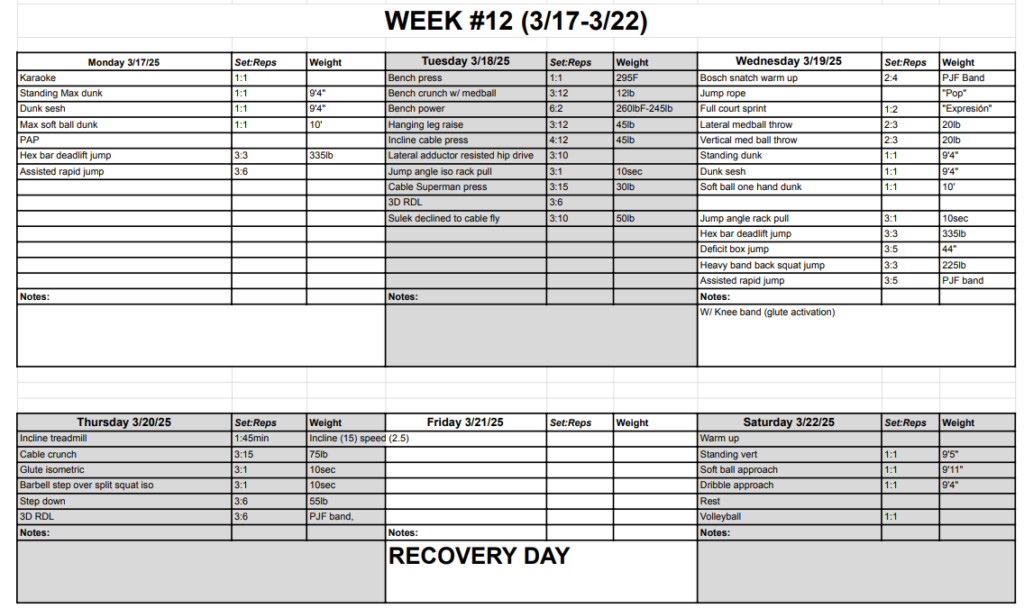
Week #12 “50% violence, 50% peace, 100% sore legs”
This week, I dropped my calorie intake to 2600 calories. Now, that might sound fine for your average person—but for a 6’1″, moderately jacked guy exercising for nearly two hours a day, that’s like like trying to power a monster truck with a lawnmower engine. Sure, it’ll start, it’ll sputter, and maybe it’ll even roll down the street—but don’t expect it to clear any jumps, and for the love of quads, don’t ask it to hit top speed..
Am I suffering? Slightly. But this is the name of the game when you’re trying to stay lean, jump higher, and still make it to arm day without turning into a human raisin.
Still Contrast Training Like My Gains Depend on It (Because They Do)
Despite the looming specter of mild malnutrition, I’m sticking with contrast training, because I genuinely believe this is the best protocol for my current goal: jumping like I’m wearing springs.
Contrast training—pairing a heavy compound lift with an unloaded explosive movement—is based on the principle of post-activation potentiation (PAP). Basically, you shock the nervous system with a heavy lift (think 85%+ of your 1-rep max), then hit it with a plyometric movement to train your muscles to recruit more fibers more efficiently.
And the science is legit. Tillin & Bishop (2009) noted that PAP increases the sensitivity of myosin and actin filaments to calcium, which leads to greater muscle fiber recruitment during explosive movements. In other words, heavy squats make your box jumps better—if you time it right.
This week, I incorporated:
- Hex bar deadlift jumps followed by band-assisted vertical jumps
- Barbell back squats followed by standing box jumps
- Heavy single-leg step-ups into explosive bounds
I’ve done this kind of work before, but this time I’m being way more deliberate. The lift is close to my max, the plyos are quick and snappy, and I’m allowing full rest between rounds (3-5 minutes). I’m not just checking boxes—I’m chasing neural adaptation.
The Podcast That Changed the Game
I listened to an episode of Andrew Huberman’s podcast featuring Stuart McMillan, and my entire worldview on speed and sprinting shifted. Like, if you thought track & field was boring, this will make you want to quit your job and become a hurdler.
Some golden nuggets from the episode:
- Speed is all about how efficiently you can transfer power into the ground. Your natural ability to be fast isn’t just in your muscles, but how you interact with the ground.
- McMillan said he can tell how fast someone is just by the sound of their footstrike. Like a boxer hitting a heavy bag—the sharp pop of a fast foot against the track.
- “Running a 100m dash is 50m of violence and 50m of peace.” I don’t know why, but that hit me deep in my soul.
- Most people think they can sprint, but don’t have the tissue or joint capacity to handle it.
- Skipping is one of the best tools to prep for sprinting—it conditions your system to move with the required range and rhythm.
- It’s not about how strong you are, but how well you transfer that strength. “Transmission of the force is more important than the magnitude of the force.“
As McMillan put it: “Movement quality matters more than movement capacity.”
And honestly, I’ve felt this myself. Ever since breaking my back in high school, I’ve subconsciously guarded my spine, keeping movements stiff and restricted. That’s over a decade of limiting my own expression and power. No wonder my jumps felt capped—I wasn’t letting the force flow.
This Week’s “Progress” (if we’re calling it that)
I didn’t hit any new PRs or break through any major barriers this week, but I did manage one thing: a killer dunk session.
I lowered the rim with a buddy and just let loose—hours of free dunking followed by three hours of volleyball that same night. Was it wise? Probably not. But it was glorious.
The aftermath? Let’s just say the recovery update is coming in next week’s post. My legs currently feel like microwaved spaghetti noodles, and I’m not entirely convinced I’ll ever stand again without creaking.
Wrapping It Up (Before I Collapse)
This week was all about putting theory into practice: cutting calories carefully, pushing neural adaptation with contrast training, and being a student of the game thanks to some high-quality content.
No crazy leaps in progress, but the process is moving—and I can feel the momentum building. Even when you don’t see the change, the wiring under the surface is being rebuilt.
I’ll end with this quote that stuck with me from the podcast: “Sports is a connection with one’s body, and the movements being expressed are you expressing yourself.”
And if that’s true, then this week I expressed the heck out of some box jumps—and maybe a little overuse soreness too.
Stay tuned for next week’s “why did I do that” episode.
References
- Tillin, N. A., & Bishop, D. (2009). Factors influencing post-activation potentiation in humans and the effects on performance. Sports Medicine, 39(2), 147-166.
- Rosenbaum, M., & Leibel, R. L. (2016). Adaptive thermogenesis in humans. International Journal of Obesity, 40(8), 1175-1185.
-

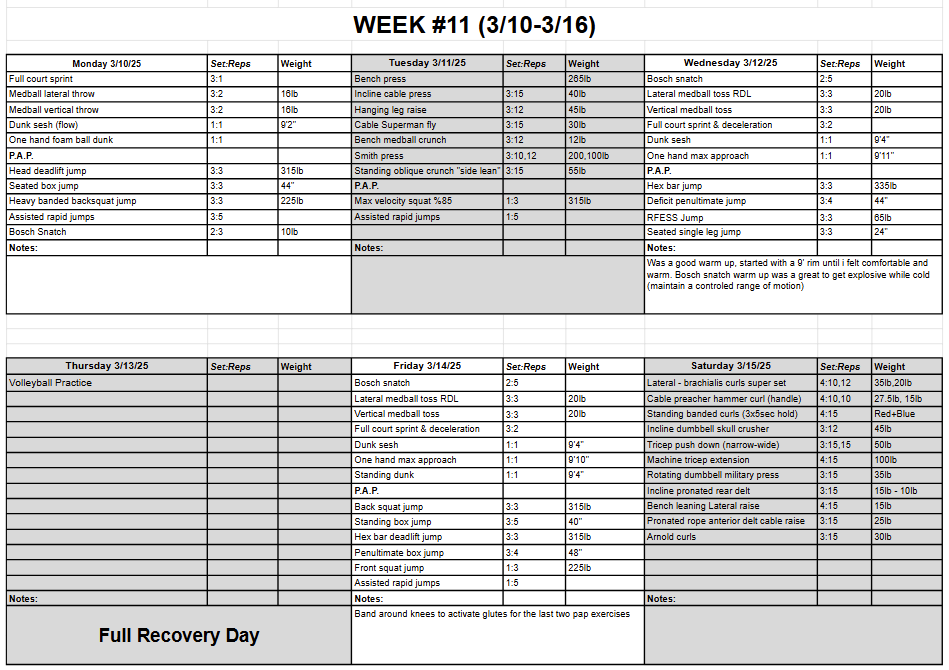
Week #11 “The Dunk Chronicles – Chapter:5 Plateau?”
Ah, Week 11 of my vertical jump training—a journey that began with the noble goal of defying gravity and executing a slam dunk that would make even Mac McClung nod in approval. Instead, I find myself in a familiar place: the Plateau Café, where the only thing being served is a tall glass of “Why am I not improving?”
Déjà Vu All Over Again
This isn’t my first rodeo with plateaus. Over the past five years, I’ve tried every method short of attaching rocket boosters to my sneakers to increase my vertical leap. Each time, initial progress gives way to a maddening standstill, like trying to sprint through molasses. At this point, I feel like I’m stuck in a bad relationship with gravity—it just won’t let me go.
I saw great progress early on, my jump numbers creeping up like an underdog team in the playoffs. But then, the momentum slowed, and suddenly, it’s like my legs forgot they were in on the plan. I know I’m on track to dunk by the end of the year, but right now? That rim still feels way too far away.
Turning Up the Heat: Intensifying the Routine
This week, I decided to spice things up by increasing the intensity of my workouts. Enter Post-Activation Potentiation (PAP), or as I like to call it, “the art of convincing your muscles they’re stronger than they think.” PAP involves performing a heavy lift followed by an explosive movement, tricking your nervous system into unlocking extra power.
Research supports this approach, showing that PAP can enhance explosive movements like vertical jumps (Nature, 2024). If high-level athletes are using it to improve power output, I figured it was worth a shot. I incorporated PAP nearly every day this week, treating my nervous system like a muscle that needs frequent reminders of what we’re trying to accomplish.
Every Day is Leg Day (Sort of)
Conventional wisdom suggests that muscles need time to recover, but neurological adaptations—like those targeted by PAP—don’t require extended downtime. By carefully monitoring volume and avoiding overtraining, it’s possible to train these adaptations more frequently. So, on my non-plyo days, instead of taking a full break, I added a heavy lift with a quick explosive exercise to keep my nervous system primed.
Some of the lifts I’ve focused on include:
- Back Squats – A staple for lower body strength.
- Back Squats with Resistance Bands – The bands increase tension at the top while allowing acceleration at the bottom, reinforcing explosive power.
- Rear-Foot Elevated Split Squats – Great for unilateral strength and balance.
- Hex Bar Deadlifts – A solid mix of strength and power generation.
Banding Together: The Glute Activation Saga
To ensure my glutes are pulling their weight (pun intended), I’ve added a medium-resistance band around my knees during heavy lifts. This counterforce promotes proper mechanics and activates the gluteus maximus more effectively. Studies show that using resistance bands during exercises like squats can significantly increase glute activation, leading to better performance (PMC, 2020).
Basically, I’m training my glutes to stop being lazy freeloaders and start acting like the powerhouses they were meant to be. The extra resistance forces me to maintain proper knee alignment, which has already made my squat mechanics feel stronger. Plus, nothing reminds you to engage your glutes like the threat of your knees caving in under heavy weight.
Signs of Life: The Needle Moves
I’m hesitant to jinx it, but I think I saw some signs of improvement this week. My jumps felt a little more explosive, and I managed to touch a rim that’s been just out of reach for months. It’s not a dunk yet, but it’s progress. And right now, I’ll take any win I can get.
Progress in strength training and athletic performance isn’t linear. There are peaks, valleys, and long, frustrating plateaus. But if I’ve learned anything in my five-year battle with gravity, it’s that you have to trust the process. Sometimes, progress is happening beneath the surface, even when you can’t see it.
The Takeaway: Keep Showing Up
Plateaus are the universe’s way of testing our resolve. They separate those who give up from those who push through. If you’re facing a similar standstill in your training, remember: adjusting your routine, incorporating scientifically-backed methods like PAP, and focusing on muscle activation can reignite progress. And if all else fails, there’s always the option of lowering the hoop—but where’s the fun in that?
I’ll keep going to the well until the well is dry. And something tells me this well isn’t empty yet. Stay tuned for Week 12, where I either break through this plateau or start considering ways to make my arms longer. Either way, it’ll be entertaining.
-
Week #10 “Eating More, Jumping Higher, and Still Overthinking Everything”
This week, I did what every lifter both dreams of and dreads: I increased my calories. After weeks of meticulous cutting, I finally let myself eat a little more. Naturally, I was paranoid that I’d wake up looking like I just inhaled an entire pizza in one sitting (which, for the record, I can do). So, to balance it out, I cranked up the cardio.
The Great Caloric Experiment: Reverse Dieting + Cardio
To offset my increased calorie intake, I hopped on the stationary bike for 60 minutes, three nights this week, keeping my heart rate steady at around 100 BPM (+/- a little bit). The goal?
- Increase caloric expenditure.
- Temporarily raise my basal metabolic rate.
- Make my reverse dieting process a little more aggressive without packing on excess fat. (don’t got time to do this slowly)
The theory here is that cardio can help regulate metabolism after prolonged calorie restriction (Rosenbaum & Leibel, 2016). When you diet aggressively, your metabolism slows down to conserve energy—a process known as adaptive thermogenesis. Research shows that strategic cardio can help counteract this effect, keeping metabolism elevated while allowing for a more rapid increase in caloric intake (Melby et al., 2017).
So far? No drastic weight gain, and I don’t feel like my lifts are suffering. That’s a win in my book.
Contrast Training: Unleashing My Inner Superhuman
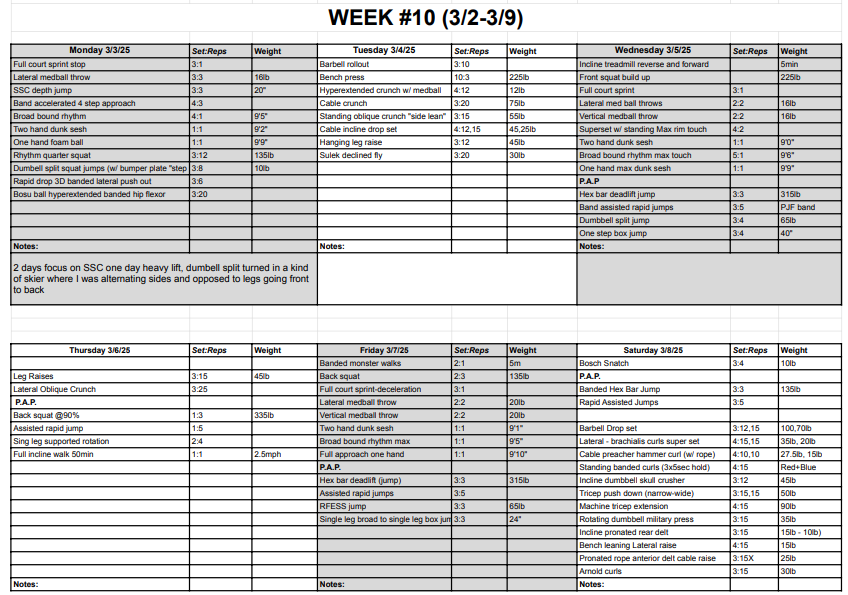
This week, I also dove into contrast training, a method based on post-activation potentiation (PAP). The logic? Lift something heavy (85%+ of 1RM) to wake up your nervous system, then immediately do an explosive plyometric movement to teach your muscles to recruit more fibers.
I have a buddy who weighs 20 pounds less than me, we’re the same height, and I’m currently leaner than he is—but somehow, he jumps higher. Unacceptable. Clearly, I have unused muscle mass, and contrast training is my new best friend.
Research supports this. A study by Tillin & Bishop (2009) found that PAP enhances muscle fiber recruitment by increasing the sensitivity of myosin and actin filaments to circulating calcium. In simple terms? Heavy lifting makes your muscles more responsive, so when you follow it up with a jump, you tap into more power.
Contrast Training in Action
I structured my sessions around maximal muscle recruitment, ensuring the heavy lift was actually close to my 1RM, rather than just going through the motions. Here’s what the setup looked like:
- Barbell Back Squat (3×3 @ 85-90% 1RM) → Standing Box Jumps (3×5) with 3+ min rest
- Hex Bar Deadlift Jumps (3×3 @ 85%) → Band-Assisted Rapid Jumps (3×5) with 3-5 min rest
For single-leg work, I alternated legs to minimize downtime and maintain myofibril sensitivity:
- Single-Leg Bulgarian Split Squat (Heavy) → Single-Leg Bound Jumps
- Heavy Step-Ups → Explosive Step-Up Jumps
I’ve done contrast training before, but never with this level of intensity. Usually, I’d sprinkle it in sporadically for a few weeks and move on. This time? I’m going until the gains start to slow. Why stop early if there’s still potential left on the table?
Upper Body: Still Grinding, But Playing It Smart
PAP and contrast training have been the main focus for my lower body, but my upper body is still getting attention. My weekly breakdown:
- Chest Day – Keeping things tuned, but not pushing PRs due to a minor strain in my right pec. I’m still training hard, just not at max weights.
- Saturday: Arm Destruction – Biceps, triceps, shoulders. Enough said.
Takeaways: More Calories, More Explosiveness, Same Level of Overthinking
So far, upping my calories hasn’t tanked my progress, and contrast training is already showing improvements in power output. I’ll keep pushing the envelope and see where it takes me.
Next goal? Finally put that 20-pound weight difference to use and stop getting out-jumped. Let’s see how much power I can unlock in the coming weeks.
References
- Melby, C. L., Paris, H. L., Foright, R. M., & Peth, J. (2017). Resistance exercise and energy balance: The effect of resistance exercise training on energy intake and energy expenditure. Sports Medicine, 47(10), 1951-1962.
- Rosenbaum, M., & Leibel, R. L. (2016). Adaptive thermogenesis in humans. International Journal of Obesity, 40(8), 1175-1185.
- Tillin, N. A., & Bishop, D. (2009). Factors influencing post-activation potentiation in humans and the effects on performance. Sports Medicine, 39(2), 147-166.
-
Week #9 “When Rest Feels Like More Work”
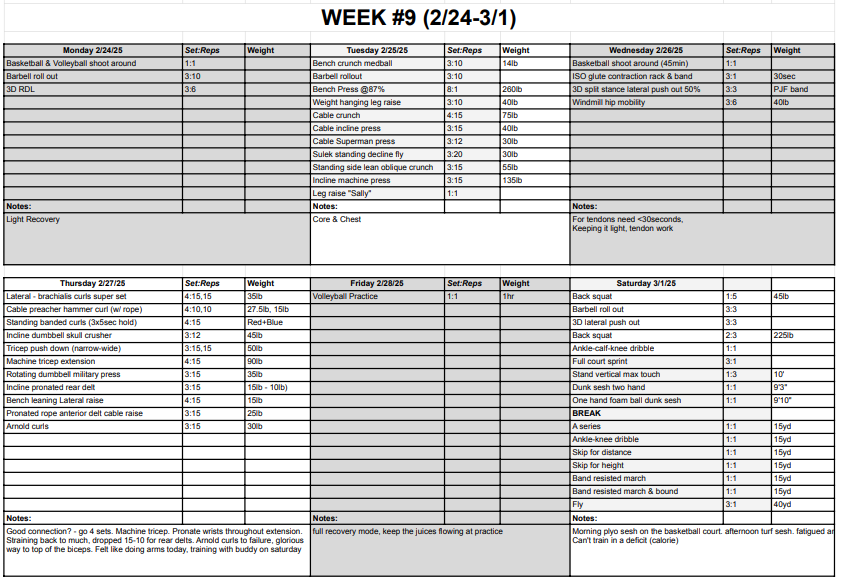
Alright, so after eight straight weeks of intense training, I finally committed to a recovery week. Sort of. I’d love to say I took it easy, did some light stretching, and emerged feeling like a brand-new human. But nope. I still don’t feel fully recovered, and, naturally, I still went balls to the wall on arm day and upper body day—because those aren’t the muscles I’m worried about overtraining. Priorities, right?
The Price of 8 Weeks of Plyos and Strength Training
For eight weeks, I’ve been hammering my legs with a minimum of three intense plyometric and strength sessions per week. That much high-impact work isn’t exactly gentle on the joints, tendons, and nervous system. And while recovery week is supposed to help, doing nothing at all actually slows the recovery process.
Why Active Recovery Works (Science Says So)
Instead of completely shutting down, I still made it to the gym, kept the weights light, and did moderate-intensity plyos. Research suggests that active recovery—low-intensity movement performed after intense training—aids muscle recovery by increasing blood flow and reducing soreness (Dupuy et al., 2018). The increased circulation helps shuttle nutrients to damaged muscles, speeding up the repair process.
In one study, researchers found that athletes who engaged in active recovery maintained higher power output and reduced muscle soreness compared to those who completely rested (Dupuy et al., 2018). So, while I wasn’t setting any PRs, at least I wasn’t deteriorating into a pile of regret and lactic acid buildup.
Rehabbing the Tendons: Isometrics for the Win
Since I had a little more time this week (not slamming my legs into the ground at full force), I incorporated isometric exercises for my glutes, knees, and hips. Why? Because isometrics put stress on tendons in a way that stimulates recovery and adaptation without excessive strain.
A 2019 study by Rio et al. found that isometric holds improve tendon health by increasing collagen synthesis and reducing pain sensitivity—which means stronger, more resilient tendons (Rio et al., 2019). And given the amount of explosive work I’ve been doing, keeping my tendons happy is essential for longevity.
Saturday: The Big Letdown
All week, I was convinced that by Saturday I’d be feeling fresh, springy, and ready to unleash some PRs on the track. I even hyped myself up to impress a buddy at a turf/track workout. Spoiler: it did not go as planned.
While I had some good moments, nothing extraordinary happened. No personal bests, no superhuman vertical leaps—just a reminder that recovery takes longer than a few days of half-hearted rest. I could tell my nervous system was still fried. The gas pedal was there, but my engine just wasn’t revving properly.
That said, I did manage to beat my brother-in-law in a 40-yard dash. Granted, I had a 10-yard head start, but that’s just a minor detail we don’t need to dwell on.
The Impact of a Caloric Deficit on Recovery
On top of the physical fatigue, I’ve also been in a cutting phase, meaning my body is operating in a caloric deficit. While that’s great for dropping body fat, extended periods of restricted calories can negatively impact strength, recovery, and performance.
Research shows that prolonged caloric deficits reduce muscle protein synthesis, slow glycogen replenishment, and increase cortisol levels, all of which make recovery even harder (Murphy et al., 2018). So, between my training load and my deficit, it’s no surprise I wasn’t bouncing off the walls by Saturday.
Looking Ahead
Next week, I’ll be reevaluating my approach to recovery, possibly incorporating more mobility work, sleep prioritization, and nutrition adjustments to help my body bounce back. Because let’s be honest—I like pushing my limits, but if I want to keep progressing, I need to be smarter about how I balance stress and recovery.
Stay tuned—because despite this week’s setbacks, I’m still coming for those PRs. Just… maybe not next week.
-
Week #8 “Muscle Science, Fatigue, and My Love-Hate Relationship with Recovery”
Progress Update: Gains, PRs, and the Art of Not Overdoing It
Alright, we’re back with another week of training updates, PRs, and a healthy dose of reality. Because as much as I’d love to report that I’m dunking already or benching a small car, we all know that’s not quite how it works.
Plyo Day #1: PR City
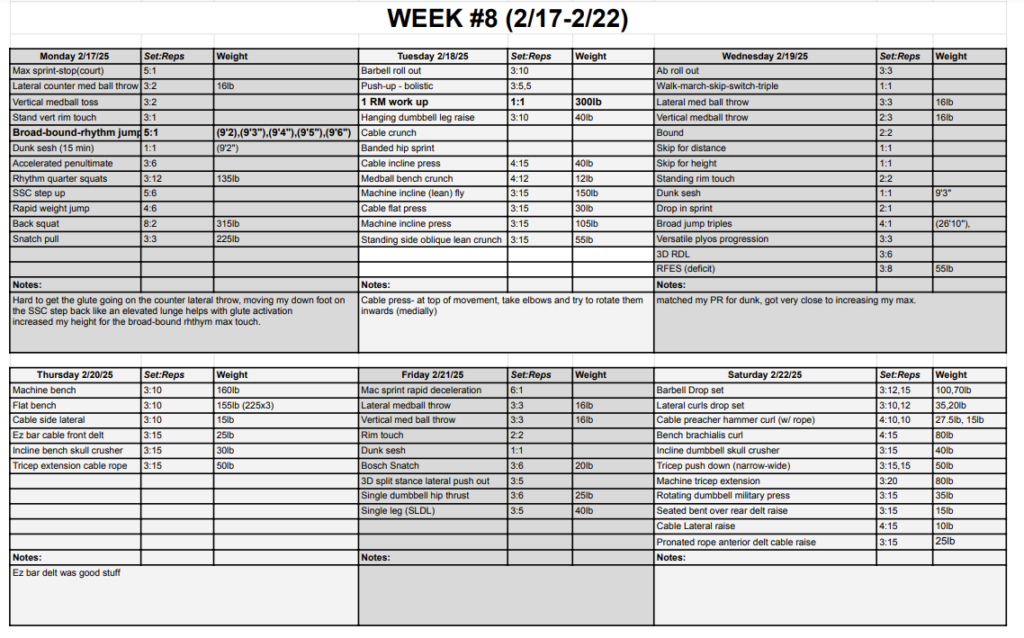
We kicked things off with a personal record (PR) on the “Broad-bound-rhythm jump.” A whole 3-inch improvement from where I started training. That’s not too shabby. Keep that up, and I’ll be dunking by the summer. Unlikely, but a guy can dream.
Core & Chest Day: The Ego Booster
Apparently, I was riding a wave because I also PR’d on my barbell bench press, increasing my one-rep max by 15 pounds since the start of the year. If I keep this up, I’ll be pressing mountains in less than a year. Again, also unlikely. But let’s appreciate the moment.
Why Am I Seeing Rapid Gains?
Hypertrophy gains (aka muscle growth) are slow—building actual muscle mass takes forever. The quick progress I’m seeing is more about neurological adaptation than sheer muscle gain. My muscles already exist, I just need to train my nervous system to use them more efficiently. Think of it like learning a skill rather than building new material.
Hypertrophy vs. Power Training
There’s a fundamental difference between training like a bodybuilder (hypertrophy-focused) and training like an Olympic lifter (power-focused). Hypertrophy training relies on high volume, moderate weight, and time under tension to build sarcoplasmic hypertrophy—which increases the fluid and energy storage in muscle cells.
Power training, on the other hand, prioritizes heavier loads, lower reps, and explosive movements to enhance myofibril hypertrophy, which increases the actual muscle fiber density and contractile strength. Bodybuilders look bigger, powerlifters lift bigger.
Sarcoplasmic vs. Myofibril Hypertrophy
- Sarcoplasmic Hypertrophy: More volume in the muscle cell, higher endurance, less raw power. Great for aesthetics, not necessarily max strength.
- Myofibril Hypertrophy: Denser muscle fibers, increased force output, but doesn’t necessarily look as big. Great for power and explosiveness.
I’m somewhere in between, aiming for functional strength that helps with jumping, speed, and power while keeping a solid muscle base.
Reality Check: Fatigue Hits Hard
After an exciting start to the week, I was hit with a wall of fatigue. No matter how much rest I got, my body was like, nah, not today. My numbers weren’t budging, and I could feel the effects of 8 straight weeks of grinding.
Focusing on the Posterior Chain
Lately, I’ve been dialing in my glutes and hamstrings. Turns out, they kind of run the show when it comes to athletic power. The best drills so far have been:
- 3D Split Stance RDLs – Focused on deep contraction and control.
- Bosch Snatch – Getting that SSC activation.
- SSC Step Ups – Training explosiveness and engagement.
I’m starting slow, focusing on the contraction and making sure I’m firing the right muscles. Once the pattern feels natural, I’m ramping up the speed to train that explosive glute power.
The Plan: Deloading Next Week
Eight weeks straight of pushing my limits has me feeling worn down. So, next week, I’ll be dialing things back a bit—lower volume, lighter loads, and just enough work to maintain movement quality without burying myself further into the fatigue hole.
Let’s see how I bounce back after some much-needed recovery. Until next time, stay strong, keep grinding, and if you’re hitting PRs, enjoy them while they last!